My Love-Hate Relationship With Crappie
PROTECTED CONTENT
If you’re a current subscriber, log in below. If you would like to subscribe, please click the subscribe tab above.
Username and Password Help
Please enter your email and we will send you a password reset link.
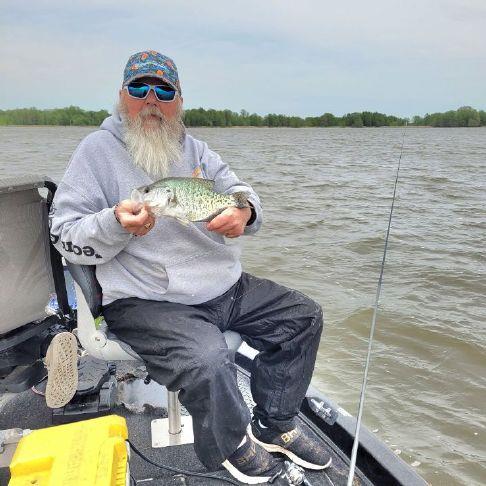
I can catch bass, and I consider myself a fairly good catfisherman. But if there is a chink in my armor, it’s crappie. It begins with the fact that, as a kid, we didn’t have crappie to go after. I fished our small farm pond, which had a good population of bluegill and a few catfish, but crappie were just as foreign to me as walleye would have been.
It wasn’t until I fished a larger farm pond south of Kahoka that I began actually going after crappie. The pond had a shallow shelf in its southwest corner that held dandy bluegill and an occasional crappie.
When we moved to higher ground following the 1993 flood, the pond on our property had a good population of crappie that I was able to catch using a live minnow and a slip bobber. But a very cold winter with a lot of snow killed off most, if not all, of my fish, so I had to start over again.
Last spring, I noticed a lot of activity in the shallows of the pond, and a white jig yielded quite a few smaller crappie, so I am anxious to see how this spring works out. I’m also a little concerned, as the pond had a visitor in the form of an otter, and he seemed a lot better at catching my crappie than I was.
To be honest, most of my crappie catches occurred when I was fishing for another species and was using a smaller jig or spinner, such as a Beetle Spin. I don’t know if I simply do not know what I’m doing or if it was just a poor day for crappie to be hitting. But if I were invited to go crappie fishing, I would look on it the same as I would if you invited me to go on a snipe hunt.
I am fully aware that crappie fishing is nearly here. Despite our occasional snow, spring will be coming. In our duck blind, while snow goose hunting, each day someone will give an update on the water temperature in the Mississippi River. We are all catfishermen, and we are looking for that magical 50 degrees to begin fishing.
There is also a sick side of me that enjoys the torture of attempting to catch crappie, so I, too, know what spring means for crappie. Trust me, it’s not from a lack of trying or even a lack of gear. I have three one-sided tackle boxes full of jigs and grubs, as well as ultralight rods.
We even became so desperate to have a great day crappie fishing that we traveled to Reelfoot Lake in Tennessee last spring. We hired a fishing guide and knocked them, but not on jigs. The secret was a 20-foot jigging pole with about six feet of line, two BB sinkers and a bare hook with a minnow. But it was worth the expense and drive, as we knocked some truly great crappie.
Understanding Crappie Behavior
Temperature means a great deal to crappie, as when the water reaches that same 50 degrees, they begin to move into shallower water. This isn’t the time to fish first thing in the morning, either, as this will be the coldest time of the day. Instead, fish in the midafternoon after the sun has had more time to warm the water. This was the time of day that I was catching crappie in my pond—around 3 p.m.
When the water reaches a temperature near 60 degrees, the fish begin to feed like crazy as they prepare to spawn. As the water warms up even more, the fishing will pick up as well. Smaller ponds, of course, will warm up quicker than larger bodies of water. But always keep in mind that, more than likely, you will find the fish in shallower, warmer water.
If this fails, then remember that crappie also like cover, whether it’s rock piles or a submerged log.
When the spawn is going on, the females lay the eggs and may have several different nests. It’s the male crappie that guard the nests. This can be a tough time to catch crappie, as this is not when they are most concerned about food. But just like bluegill, you can catch fish that are guarding the nests.
Best Fishing Techniques
If I’m in my little 10-foot boat, then it’s easier to jig fish than to cast and reel the lure to shore. The goal is to keep the jig at the depth where the fish are suspended.
If I’m fishing from shore, I like to use a slip bobber to maintain the jig at a certain depth. I have used live bait under that slip bobber, including minnows and pieces of nightcrawlers. I have even had some luck using Berkley Power Nibs.
In a few weeks, the Bass Pro Shops annual catalog will arrive. The choices of colors and styles of jigs will be extensive. I have a wide selection in my tackle box, as I thought that was what I needed to be proficient at catching my nemesis—crappie.
But in the end, you can get by with less if you just keep it simple. While I stated that I’m not a crappie fisherman, I have had my most luck on a black/chartreuse combination or just straight chartreuse.
But around the docks at Mark Twain Lake, if I’m not using a minnow, then it may be something in orange, red, hot pink or any color with a chartreuse tail. On occasion, I will also use a jig that resembles a minnow, such as a silvery white color with black flakes on it. White curly tail grubs will also catch fish, and then there are the old tried-and-true marabou jigs that always seem to produce.
Choosing the Right Gear
The size of the gear used is also important. When using live bait, I like a size 6 to 8 hook, especially in crystal-clear water. I also prefer a wire hook that can straighten out fairly easily.
I’m not worried about hooking the fish, as crappie are known for thin mouths, but when fishing in cover, I want that hook to straighten out enough to allow me to pull it free rather than lose the hook and sinkers.
More than likely, I will also use 4- to 6-pound test line, so I cannot get too forceful with it. The most popular jig size for crappie is 1/16 ounce. If you are fishing in deeper water and want to get that jig down, increase the weight to 3/16 or 1/8 ounce. Some crappie fishermen prefer 1/32-ounce jigs.
Perhaps just as important as the size of the jig is how it is attached to the line. In order to look like a minnow—or whatever the crappie thinks that jig is—it must hang in the water horizontally.
Jigging Technique
I mentioned jigging a lot in this story, and I suppose I should explain what it is. Think of jigging like working a yo-yo while making your retrieve.
You cast the jig out, and when it reaches the depth where you believe the fish are, you reel in slowly—but fast enough to keep it from going any deeper than you want. As you retrieve the jig, you raise the rod tip up and then lower it. It’s best to keep the motion smooth rather than jerky, as it will resemble a live critter. This is especially true if the water is still fairly cold.
Related Posts
Uncertain Future for Kahoka Blood Drives