Countdown for Early Canada Goose Season Begins
PROTECTED CONTENT
If you’re a current subscriber, log in below. If you would like to subscribe, please click the subscribe tab above.
Username and Password Help
Please enter your email and we will send you a password reset link.
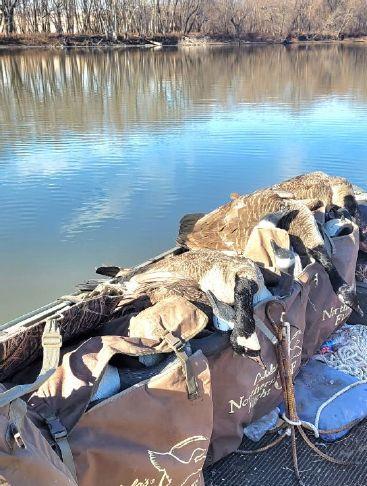
A few months ago, while returning from a catfishing trip on the river with a good friend, he showed me some Canada goose decoys he had given new life to by repainting them. I knew I had several bunches of goose decoys in the same condition, fitting into the old Montgomery Ward paint categories: good, better and best. I’m very familiar with Montgomery Ward paint, as I sold it out of the Keokuk store many years ago.
I asked my friend if he’d repaint those decoys that had fallen into “sub-good” condition and were gray — well, as gray as my beard! He graciously agreed, and when I got them back, they were amazing. I look forward to getting the chance to use them. That chance is less than a month away with the opening of the early Canada goose season. It begins Oct. 4 and runs through Oct. 12, with a daily limit of three geese. As always, check your wildlife code pamphlet for more information.
If I had to choose a time to hunt Canada geese, it would probably be late winter, when duck season is closed and geese are just about the only game left. But if I get a chance to hunt waterfowl, I’ll take it whenever I can.
Late-season goose hunting often targets the same local geese present year-round, but it can also include migrators when water freezes up north or snow covers crop fields. These geese have faced hunting pressure from wherever they hatched or nested. Because of that, they can be tougher to call in and might only respond to decoys that closely resemble the real thing.
Whether they’re young or old, early-season geese are often experiencing their first hunt — unless they have remarkable memories I’m unaware of. That doesn’t mean they’ll be easy, but for some, their first encounter with hunters will also be their last.
For those who don’t enjoy freezing their rear end off, the early October Canada goose season might even see hunters wearing shorts in layout blinds or under waders to stay cool. That’s in contrast to the late-season goose hunter, who’s wearing as many layers as possible just to stay warm and mobile. The warmth of early season also makes it a great time to introduce a youngster to Canada goose hunting. If you’re field hunting or using a portable setup, a layout blind can last them for years.
While Canada geese are plentiful today and can be found on most large farm ponds or golf courses, harvesting one is still a big deal for a first-time hunter. I remember taking my first Canada goose. My Uncle Jack and I went down the river ahead of Dad, who was waiting for other hunters to load up in his boat. We arrived at the blind early and flushed a Canada goose out of the decoys. I was so proud of that goose and couldn’t wait for Dad to see it. Back then, Canada geese were hard to come by. If we harvested a couple a year, it was considered a good season. That’s why our family and friends would travel to Swan Lake and Fountain Grove to hunt them.
As I said, early-season hunting is focused on local birds, and you’ll have ample opportunity to pattern their routine, as they tend to fly the same paths morning and evening. The two most important keys to success? Scouting and concealment.
Once you learn the flight pattern, position yourself along their route. The best strategy is to be mobile enough to reach the field where they’ve been feeding, ideally getting there before they do. That looks natural to them. It’s difficult to pull them away from known feeding grounds. The action may not happen first thing in the morning, but we’ve had good luck on smaller bodies of water that geese visit post-feeding.
Put the same effort into creating a realistic spread as you would for a field hunt. I place most of my decoy floaters on the water and add a few sleeper decoys along the shoreline or pond dam. Drive by any pond or lake with geese, and you’ll see the same. I prefer a good mix of decoy poses, as real geese don’t all stand alert unless they’re about to take off. Finally, I keep my decoys within shooting range of the blind, whether it’s permanent or a layout blind. If geese land outside your decoy spread, they’re no help — not only are they out of range, but the next flock always seems to join the real birds.
September is the time to buy your non-toxic ammo, as many retail stores offer specials this time of year. Even if they don’t, they typically have large inventories. Having to run to town to buy steel shot one box at a time means you may be forced to take what’s available instead of what you actually want. I still buy local when I can, but if you and your hunting buddies are planning to buy by the case, splitting cases and costs makes sense.
Long before the 3½-inch craze, waterfowl hunters took geese with 3-inch and even 2¾-inch loads. Of course, that was before steel shot was required. My dad never used 3½- or even 3-inch shells — his old Browning A-5 wasn’t chambered for them. But he still took his share of Canada geese. It was all over decoys, where shots are closer and more controlled, assuming your setup and concealment are sound. Approaching geese are easier to bring down than departing ones.
Early-season geese may not be as heavily feathered as late-season migrators, so I don’t feel undergunned saving my 3½-inch shells for December and January. I use 3-inch — or even 2¾-inch — loads for the early season. Besides, lighter-recoiling shells are easier to manage in a T-shirt than in a parka.
Related Posts