Closing Out Waterfowl Hunting With Snows
PROTECTED CONTENT
If you’re a current subscriber, log in below. If you would like to subscribe, please click the subscribe tab above.
Username and Password Help
Please enter your email and we will send you a password reset link.
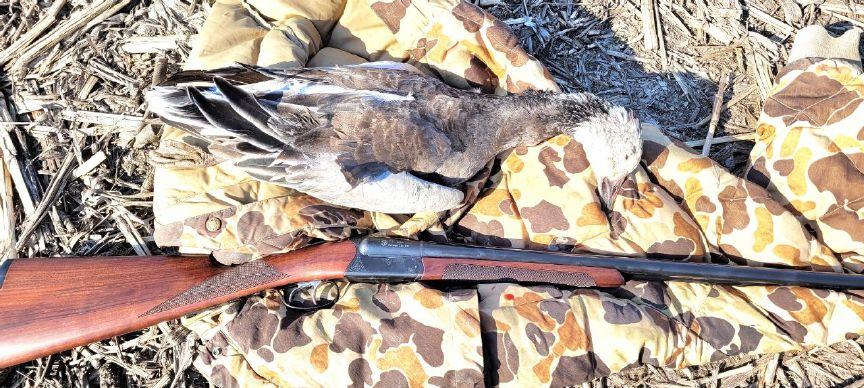
Two weeks ago, Kenny Garkie and I sat in his boat blind, attempting to take a few more Canada geese while the season was still open. We managed to scratch down one that morning. Though we saw a few Canada geese, only one came close enough. What we did see, however, were flock after flock of snow geese making their spring migration.
These geese were traveling from the east to slightly northwest. I have no idea where they were headed, as there was still snow to our north—at least in the great state of Minnesota. But watching those geese pass overhead once again had us thinking about snow goose hunting.
It’s a tough hunt for several reasons, and Kenny summed it up well when he said, “I love watching those geese circle the decoys, but they are the most aggravating thing to hunt! They also require a great deal of work!”
Let me go over this one more time: The Light Goose Conservation Order runs from Feb. 7 to April 30. Hunting is limited to snow geese, blue geese, and Ross’s geese. You’re allowed to shoot a half-hour before sunrise and a half-hour after sunset. The order is an attempt to control the population of these geese.
You can use an electronic call and remove the magazine plug from your shotgun, allowing it to hold more than three shells. There’s also no bag limit. However, you must use nontoxic ammunition and obtain a Conservation Order permit.
When Kenny mentioned the amount of work involved, he was talking about the decoys. Snow goose hunters are convinced that the more decoys you have out, the better your chances of pulling geese down. This often means setting out 400 to 500 decoys.
Setting them up is hard enough, but finding people to help usually isn’t too difficult—at least at the start of the season. After a month and a half of being rejected by thousands of snow geese, though, you develop a bitter taste toward the whole process.
By the end of the season, fishing is starting to pick up, so excuses for not helping gather decoys become plentiful. And because the decoys stay out all season, at least a couple of spring storms are bound to pass through. What looked perfect the day before can look like a disaster zone the next. You’ll end up spending the better part of the morning recovering decoys scattered by the same wind that blew Dorothy out of Kansas.
So, if it’s such a hassle, why do it?
To be honest, I have a stubborn side. I can hit a golf ball into water with no problem—especially when I’m trying to lay up. But it’s that one shot that makes me look like I know what I’m doing that keeps me coming back.
It’s the same with snow goose hunting. Hundreds may fly by without a glance at my decoys, but when that one flock peels off, circles a few times, and finally drops into range, it makes me forget all the misery. Those moments may be few and far between, but they’re enough to keep me coming back.
I remember heading to our farm alone a few years ago after church. As I changed clothes in the cabin, I could hear snow geese flying overhead and felt that familiar excitement to get out among the decoys.
As I walked into the spread, one flock had already passed, but another was approaching in the distance. I turned on the electronic caller, sat down, and loaded my Browning A5. With the plug removed, it holds four 3-inch shells.
Leaning back in my chair—its legs cut off so I could sit flat on the ground—I watched the geese fly directly overhead. Four snow geese broke off to the right of the main flock and began circling my decoys. They started their descent from a couple hundred yards up, but each pass brought them closer.
Then, out of nowhere, another group of about 20 snow geese appeared 50 yards above the first four and began circling too.
I now had a decision to make. The four geese would be within 30 yards on their next pass, while the larger flock was still twice that distance. The choice was simple. Even if 200 geese were behind them, I only had four shells—and I wasn’t going to hit four geese anyway.
When the smaller group flew in with their feet down, my A5 was already at my shoulder. The first shot folded the nearest goose. I swung quickly at the next but missed clean. Taking a moment to regroup, I aimed more carefully and hit another, though it stayed airborne. My final shot knocked it down, giving me a 50% success rate.
Snow geese are unpredictable, but I’ve seen it happen countless times—especially with Ross’s geese. One of the two remaining geese flew out about 100 yards, then circled back to the decoys. By then, I’d already reloaded two shells. When it flew within range, I added it to my take.
When I gathered the birds, I realized the four were a mix of snow geese and Ross’s geese.
Just retelling this story has me itching to go again this spring. In fact, halfway through writing this, I called Kenny to see if he was still up for it. I must’ve caught him in a weak moment because he said, “Sure.”
With that, I suddenly had something to do on a cold winter day. I headed to the basement to check the electronic call, make sure the battery was good, and charge it. While I was there, I grabbed some ammo and packed my blind bag. Next stop: the garage to take inventory of my Texas rag decoys and flying decoys.
That’s the other reason I hunt snow geese—it gives me a reason to get up and do something, whether I’m successful or not.
Related Posts
Uncertain Future for Kahoka Blood Drives