Planning A Port
PROTECTED CONTENT
If you’re a current subscriber, log in below. If you would like to subscribe, please click the subscribe tab above.
Username and Password Help
Please enter your email and we will send you a password reset link.
By Mike Scott
“We need to get Clark County on the move,” said Henry Dienst.
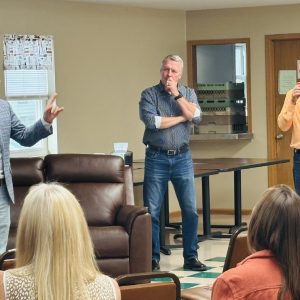
On Tuesday, October 3, the Easter District commissioner led a public hearing to outline the county’s NEMO PORT Port Authority Application.
“We are able to apply for permitting from MoDOT because we have the data to back up that it is viable,” he added.
A strategic port study has been completed by Decision Innovation Solutions, Bujanda and Allen, and MECO Engineer to provide a comprehensive analysis of the marine highways, port authorities, river terminals and docks with a 200 mile study area.
Former Presiding Commissioner Buddy Kattelmann noted that Clark County began this process several years ago with a $300 dollar investment, which allowed them to receive a $250,000 grant from the Missouri Agricultural and Small Business Development Authority to fund the strategic study.
The project identified more than a dozen potential private partners interested in the creation of a port facility in this region, the report presented at the meeting said.
The proposed site of the future intermodal port includes approximately 298 acres along the Mississippi River near Alexandria, between Highways 61/136 and the river, from the levee at Alexandria upstream to a point roughly perpendicular to the Smoker’s Outlet on Hwy. 136.
“I want to make clear there are no definite plans for any certain location at this time,” said Deinst.
The proposed location offers access to both railroad and highways, including the nearby Avenue of the Saints.
According to the report, the “scope of the work would include land acquisition and earthwork and site preparation to elevate the site to one foot above the base flood elevation. A 6000 foot on-site rail spur is proposed, as well as road access to US 61”.
The proposal includes a dock and crane facility for container loading and unloading, and additional development may include facilities for agribulk, dry bulk, and liquid bulk cargoes.
The proposed port would serve the tri-state area as river traffic grows.
“It looks like traffic on the river is going to increase by leaps and bounds,” said Dienst. “We have to be ready.”
Chris Feeney, Transporation Planner and Economic Development Specialist with Northeast Missouri Regional Planning Commission in Memphis, agreed.
“There is a tremendous emphasis on port infrastructure at the federal level,” Feeney said. “There is currently about $450 million dollars per year available for port infrastructure.”
Feeney added that currently, only about five percent of all freight travels on water, but is expected to grow to over 20 percent in the next few years.
“Besides the federal money, the state is making $10- 15 million dollars per year available in port capital expense,” Feeney said.
Any federal spending would come in the form of an 80/20 grant,” said Kattelmann. “The State of Missouri might provide the other 20 percent.”
It is estimated that the port could handle 550,000 metric tons of domestic volume and another 400,000-650,000 tons of international volume.
Kattelmann also stressed that the proposed port could be used at least nine months per year, compared to only three or four months per year for ports on the Missouri River.
Another benefit of the location is that the river will not need dredging.
“We have 30 to 50 feet of water there, that will never need dredging out,” Kattelmann added.
“We have everything we need to compete with Cape Girardeau,” he said.
Dienst added that, in addition to the business created by the port, there is a possibility of warehousing on the site.
Kattelmann agreed.
“It’s probably going to bring in other businesses,” he said.
According to the report, “the initial direct investment of $37.8 million in capital for the construction of the facility results in an estimated total impact of $67.9 million in output, $32.7 million in value added, and $22.1 million in labor income. An estimated total of 66 jobs would be supported.”
“We need to do this for our grandkids,” said board member Paul Brotherton.
Board member Charles West agreed, saying that because of the jobs and tax revenue, the project would be good for everyone in Clark County.
The current members of the port authority board are Henry Dienst, Frank Shipley, Charles West, Brian Elam, Buddy Kattlemann, Paul Brotherton, Jim Sherwood, Gary Trump and Bill Schutte.
While several board members indicated that it would be years before any development started, Feeney said that once the Port Authority status is granted, the organization could apply for grant funding as early as November.
Related Posts