And They’re Off: Local Harness Racers Reminisce About Racing Their Horses on the Track
PROTECTED CONTENT
If you’re a current subscriber, log in below. If you would like to subscribe, please click the subscribe tab above.
Username and Password Help
Please enter your email and we will send you a password reset link.
By Emily Bontrager
The bugle horn blares as the pounding sound of the horses running echoes off the grandstands. Fairgoers look to their left to see the truck and starting gate fly ahead of the harness racers and their athletic animals as they start down the straight away.
The crowd cheers for their favorite driver and horse as the truck moves off the track and the horses round the first corner.
All of the days of training come down to this moment on the track, as the drivers maneuver around each other to try to win the race. Two of these drivers are well known harness racers in Clark County.
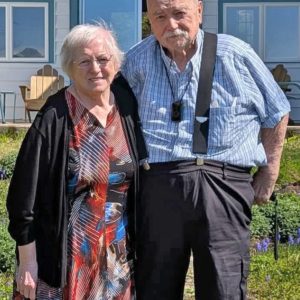
The first driver is Charles Louis Alber also known as C.L. ‘Doc’ Alber.
Doc, 93, moved to Kahoka, Missouri in 1960 with his wife and son after graduating from veterinary school. Doc grew up around horses and drove them on the farm in his teenage years until tractors replaced the horses.
Doc is now retired, and he has owned, driven, and trained Standardbred horses to compete in harness racing for many years. At the moment, Doc owns one Standardbred horse, but he has had as many as three at once in the past.
“I’ve had some good horses and I’ve had some poor horses and the expense of each one of them is the same,” Doc laughed.
The person who got Doc to buy his first Standardbred horse was Cecil Chrisman.
“Cecil Chrisman, from Revere, was my promotor. He encouraged me to buy this horse there at the fairgrounds I think in 1984. A fellow was there with five or six horses from Kansas by the name of Lauren Green. It was pretty dry in Kansas and he didn’t have much feed with him. Cecil offered him so much money for this horse. It was a two-year-old and he sold the horse to Cecil, who sold him to me. He then bought horse feed for the rest of his horses,” Doc explained.
“This particular horse I got was named Copper Goose. You would have a bucket of water in the stall and he would take his mouth full of hay and he would dip it in the water bucket and soak it before he ate it. We always thought that was because it was so dry in Kansas and he wanted moist food.”
The second driver from the area is Tom Shipley of Kahoka, Missouri. Tom, 68, used to work for the railroad. He also owns, drives, and trains his own harness racing horses and owns three Standardbred horses now.
In 1978, Tom Shipley bought his first horse and began to train it. Raising Standardbred horses and training them is a lot of hard work.
To train each horse for harness racing, Tom and Doc spend a lot of time training the horses to run on the track with a practice cart they drive behind them.
“I buy yearlings every year and put the harness on and get them to drive and steer. I drive them every day in the winter and they eventually come around,” Tom explained.
“You have to do it every day, you can’t just do it today and then come back a month later and do it.”
Each one of these drivers has spent years training horses to harness race. Back in the 1980’s there were a lot more harness races happening in the area compared to today.
“Down here at the fair they had horse racing and they raced three days a week. On Friday afternoon, Saturday, and Sunday. They would usually run about eight or nine heats of races a day,” Doc recalled.
“Back then, you raced a horse two dashes. You would race a dash and then they would go through the card, maybe six or seven races, and then you would come and race the second time. That has all changed now.”
A horse can now only enter one race at the racing events and if your horse wins you get some of the winning purse. The purse or the total money that is paid in each race category, is split up between the top finishers.
According to Doc, first place usually receives 45% of the purse, second receives 25%, third receives 15%, fourth receives 10%, and fifth receives 5%. The percentage and purse amount each driver gets differs from each racing event.
Races can take place on dirt tracks, but most places have limestone all-weather tracks that the horses compete on. The horses pull a ‘sulky’ or cart down the track where the driver sits and steers the horse.
Each race is one mile long, but most of the tracks Doc and Tom race on are half-mile tracks. Typically, there are seven horses entered into each race. The heats in each race are made up of horses who race with different gaits, which include pace and trot races.
Pacer and trotter horses are very different in how they move their legs when they race.
“A pacing horse moves their left front leg and left hind leg forward while the right side goes back. With a trotter they move their left front leg back and their right hind leg comes forward,” Tom explained.
“The second horse I had was a pacer, but I kinda ended up going to the trotters because I didn’t have to train them quite so fast. At that time, we thought it was less dangerous, but now I’m not sure,” Doc laughed.
“I think there are more trotters now than there are pacers,” Tom added.
The two drivers have won a few races over the years and they are still as excited to win a race as they were before. Harness racing is an exciting sport, but you can see that the sport is declining in the area.
“We have to race in Iowa, and I go about the furthest to race than anybody that races on the circuit. Doc does the same thing. One place I race is about 5 ½ hours one way and we race up there about seven to eight times a year,” Tom said.
“They used to race at Sedalia at the state fair, Des Moines at the state fair, but not anymore,” Doc said.
According to Tom, there are some younger generations driving, but it still seems like the races are declining.
“Up through the Iowa circuit we have young people driving and we’ve started to get a few women who drive now in the races, but it is kind of dying I’d say,” Tom said.
“The cost is a problem. Feed gets higher and everything gets higher,” Doc said.
Tom and Doc would like to see others get into the sport if they are interested. If anyone wants to learn about harness racing, Tom says you are welcome to go to the horse barn at the fairgrounds to talk about harness racing.
One of the many great things about our small community is that the Clark County Fair still holds harness races. The local fair is the only place left in Missouri that holds this event. Tom and Doc are glad that the fair still has this event and that they are able to use the track to practice on throughout the year.
The two drivers will be racing against each other at this year’s Clark County Fair. The harness racing is scheduled to start at 12:30 p.m. on Sunday, July 23 at the fairgrounds outside of Kahoka, Missouri.
Doc said that this may be his last year driving, so you don’t want to miss out on the harness racing and seeing these two dedicated horsemen race around the track!
Related Posts
Uncertain Future for Kahoka Blood Drives